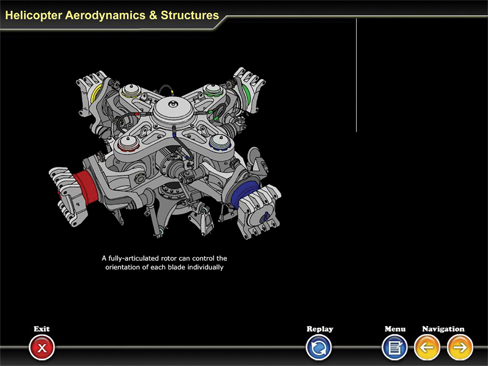
Our training is not limited to airplanes. EASA 66 Module 12 covers Helicopter Aerodynamics, Flight Controls, and Systems. The module also presents topics relevant to helicopter maintenance such as Blade Tracking and Vibration Analysis.
- 12.1 Theory of Flight - Rotary Wing Aerodynamics
- Terminology;
Effects of gyroscopic precession;
Torque reaction and directional control;
Dissymmetry of lift, Blade tip stall;
Translating tendency and its correction;
Coriolis effect and compensation;
Vortex ring state, power settling, over-pitching;
Auto-rotation;
Ground effect
- Terminology;
- 12.2 Flight Control Systems
- Cyclic control;
Collective control;
Swashplate;
Yaw control: Anti -Torque Control, Tail rotor, bleed air;
Main Rotor Head: Design and Operation features;
Blade Dampers: Function and construction;
Rotor Blades: Main and tail rotor blade construction and attachment;
Trim control, fixed and adjustable stabilizers;
System operation: manual, hydraulic, electrical and fly-by-wire;
Artificial feel;
Balancing and Rigging.
- Cyclic control;
- 12.3 Blade Tracking and Vibration Analysis
- Rotor alignment;
Main and tail rotor tracking;
Static and dynamic balancing;
Vibration types, vibration reduction methods;
Ground resonance
- Rotor alignment;
- 12.4 Transmissions
- Gear boxes, main and tail rotors;
Clutches, free wheel units and rotor brake.
- Gear boxes, main and tail rotors;
- 12.5 Airframe Structures
- a) Airworthiness requirements for structural strength;
Structural classification, primary, secondary and tertiary;
Fail safe, safe life, damage tolerance concepts;
Zonal and station identification systems;
Stress, strain, bending, compression, shear,
torsion, tension, hoop stress, fatigue;
Drains and ventilation provisions;
System installation provisions;
Lightning strike protection provision; -
b) Construction methods of- stressed skin fuselage,formers, stringers, longerons, bulkheads,frames, doublers, struts, ties, beams, floor structures,reinforcement, methods of skinning and anti-corrosive protection.Pylon, stabilizer and undercarriage attachments;
Seat installation;
Doors: Construction mechanisms, operation and safety devices;
Windows and windscreen construction;
Fuel storage;
Firewalls;
Engine mounts;
Structure assembly techniques: riveting, bolting, bonding;
Methods of surface protection, such as chromating,anodizing, painting;
Airframe symmetry: methods of alignment and symmetry checks.
- a) Airworthiness requirements for structural strength;
- 12.6 Air Conditioning (ATA 21)
- Air supply
Sources of air supply including engine bleed and ground cart;
Air Conditioning Air conditioning systems;
Distribution systems;
Flow and temperature control systems;
Protection and warning devices.
- Air supply
- 12.7 Instruments/Avionic Systems)
- Instrument Systems (ATA 31)
Pilot static: altimeter, air speed indicator, vertical speed indicator;
Gyroscopic: artificial horizon, attitude director,direction indicator, horizontal situation indicator,turn and slip indicator, turn coordinator;
Cabin Furnishing Installation;
Compasses: direct reading, remote reading;
Vibration indicating systems - HUMS;
Other aircraft system indication.Avionic Systems Fundamentals of system layouts and operation of: Auto Flight (ATA 22);
Communications (ATA 23);
Navigation Systems (ATA 34)
- Instrument Systems (ATA 31)
- 12.8 Electrical Power (ATA 24)
- Batteries Installation and Operation;
DC power generation, AC power generation;
Emergency power generation;
Power distribution;
Inverters, transformers, rectifiers;
External/Ground power.
- Batteries Installation and Operation;
- 12.9 Equipment and Furnishings (ATA 25)
- a) Emergency equipment requirements;
Seats, harnesses and belts;
Lifting systems; -
b) Emergency flotation systems;
Cabin layout, cargo retention;
Equipment layout;
Cabin Furnishing Installation
- a) Emergency equipment requirements;
- 12.10 Fire Protection (ATA 26)
- Fire and smoke detection and warning systems;
Fire extinguishing systems;
System tests.
- Fire and smoke detection and warning systems;
- 12.11 Fuel Systems (ATA 28)
- System layout;
Fuel tanks;
Supply systems;
Dumping, venting and draining; electric, mechanical, pneumatic;
Indications and warnings;
Refuelling and defuelling.
- System layout;
- 12.12 Hydraulic Power (ATA 29)
- System layout;
Hydraulic fluids;
Hydraulic reservoirs and accumulators;
Pressure generation: electric, mechanical, pneumatic;
Emergency pressure generation;
Pressure Control;
Power distribution;
Indication and warning systems;
Interface with other systems.
- System layout;
- 12.13 Ice and Rain Protection (ATA 30)
- Ice formation, classification and detection;
Anti-icing and De-icing systems: electrical, hot air and chemical;
Probe and drain heating.
- Ice formation, classification and detection;
- 12.14 Landing Gear (ATA 32)
- shock absorbing;
Extension and retraction systems: normal and emergency;
Indications and warning;
Steering;
- shock absorbing;
- 12.15 Lights (ATA 33)
- External: navigation, landing, taxiing, ice;
Internal: cabin, cockpit, cargo;
Emergency.
- External: navigation, landing, taxiing, ice;
- 12.16 Pneumatic/Vacuum System (ATA 36)
- System layout;
Sources: engine / APU, compressors, reservoirs, ground supply;
Pressure control;
Distribution;
Indications and warnings;
Interfaces with other systems.
- System layout;